Essay
After Emergence
What I learned building PRISM is not that the world has levels. It is that levels are what remain when prediction stops caring about detail.
What an explanation owes you #
For a long time I carried an unexamined confidence that the world comes with levels attached.
Physics, then chemistry, then biology, then minds, then societies. The list varies, but the feeling is consistent. Reality is layered, and if you look closely enough you can tell where one layer ends and the next begins. It is a comforting picture, partly because it makes knowledge feel like building a home: lay foundations, add floors, climb upwards.
I still think that picture is useful, but I no longer think it is the right starting point. Over the past few months I have been working on a framework called PRISM, an attempt to recover macroscopic predictive structure directly from time-series data under explicit constraints. The work is technical, and most of the time it felt ordinary in the way real work does: small choices, long runs, suspicious plots, minor corrections. What surprised me was not any single result, but the gradual change in what I now consider a serious explanation.
The shift is hard to summarise without sounding like I am trying to sell a worldview. I am not. What I can do is describe the mechanism of the shift, because it came from seeing the same kind of object often enough that my intuitions eventually moved to match it.
The observer, made explicit #
PRISM begins by admitting something that science often handles implicitly: every observer has limits.
Not limits in attention or intelligence, but limits in representation. You can only carry so much of the past forward. You choose what to keep, what to discard, what to compress, and that choice shapes what the world looks like through your model.
So we formalise the observer as a predictive device. It takes the past of a process, compresses it into a representation with limited capacity, and uses that representation to predict the future. Capacity can mean memory length, latent dimension, basis size, bandwidth, model class. The detail matters less than the discipline: the constraint is explicit and adjustable.
Then you do something slightly austere, almost unromantic. You tighten and relax the constraint and you watch what changes.
At each capacity level, you build the best predictor you can within that restriction. You then group together past representations that imply similar predictions. Those groups are predictive macrostates: not assumed, but inferred. Finally, you measure what you gained in predictive performance and what you paid in complexity to get it.
If that sounds like a machine for producing plots, it is. But the plots have a way of teaching you, if you let them.
The curve that keeps showing up #
Once you sweep capacity across a range, a familiar shape appears.
At low capacity, prediction improves quickly because you are retaining obviously relevant information you were previously discarding. As you add capacity, improvement slows. Eventually it becomes marginal, even as the inferred structure continues to grow more elaborate. Contexts split, state counts rise, transition graphs become intricate. The model acquires detail faster than it acquires predictive power.
Accuracy saturates before structure does.
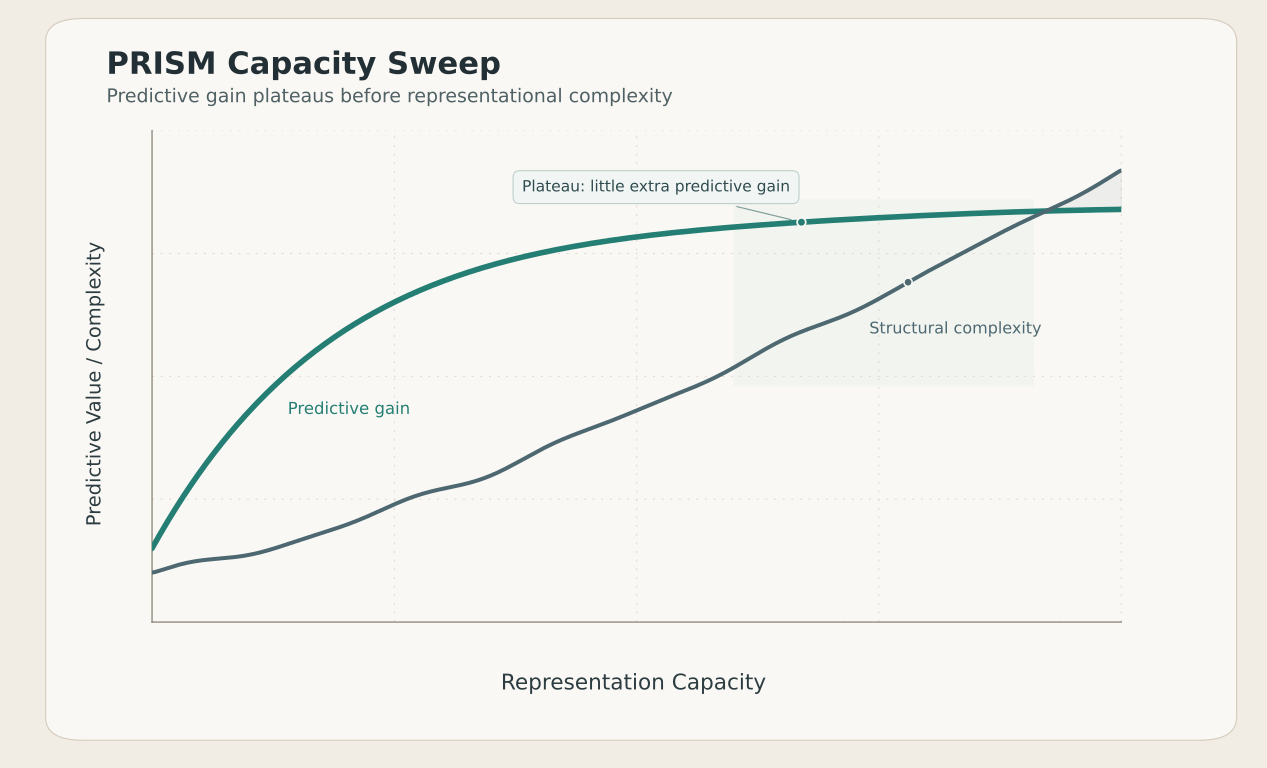
That single fact is easy to state and difficult to unsee. It suggests that a great deal of the complexity we can recover from data is not, by itself, evidence of anything “higher” or “deeper”. Complexity is cheap. Structure is easy to hallucinate if you reward it. What is rarer is structure that remains coherent when you change the constraint, resample the data, or shift the prediction target slightly.
In that distinction, the word “emergence” begins to mean something more than taste. It becomes a shape you start to recognise elsewhere once you have paid attention to it for long enough.
How a description earns the right to exist #
This is where my view changed, because it offered a different criterion for reality than the one I had been implicitly using.
I used to think of macroscopic descriptions as either conveniences or discoveries. Either we choose them because they are useful, or we find them because the world has them. It is a neat dichotomy, and it flatters our intuitions. It also breaks down the moment you try to justify an abstraction without quietly smuggling in what you hoped to conclude.
The trade-off curve suggests a third option, one that feels less dramatic and more dependable. A description earns the right to exist when it survives compression without losing its predictive grip.
Emergence, in this sense, is not a mysterious jump from parts to wholes. It is the appearance of stable predictive structure under constraint.
This is a smaller claim than people often want, but it is also harder to dismiss.
Scale is a plateau, not a ladder #
Once you accept that, scale begins to look less like a hierarchy and more like a landscape.
The older picture implies that the world is layered and our job is to discover the correct staircase. The PRISM picture suggests that the world admits many possible compressions, and only some of them are robust enough to support their own effective dynamics. Those robust compressions are what we tend to call “levels”, “states”, “laws”, “mechanisms”.
The point is not that everything is relative. The point is that any statement about scale is incomplete unless you specify the constraint under which that scale becomes visible.
Architects do not ignore molecular dynamics because molecules do not matter. They ignore them because, for the questions that architecture must answer, there exist macroscopic variables that make molecular detail redundant. Stress and strain are not metaphysical prizes; they are compressions that keep working.
In that light, the “right level” is not a rung you reach by climbing. It is a plateau you recognise because prediction stops caring about detail before explanation collapses.
That is a slightly unsettling thought, because it implies that the world does not owe you a unique decomposition. It also implies something more hopeful: you can discover useful decompositions without pretending you already know what the right variables are.
A quieter change in my attention #
This has not made me hostile to large explanations. It has made me more attentive to what those explanations owe their readers.
When someone says a behaviour “emerges” in a neural network, I now want to know what was constrained and what was being predicted. What happens to the claimed structure if you tighten the representational bottleneck, change the prediction horizon, or perturb the data slightly? Does the macrostate picture persist, or does it dissolve into artefacts of estimation?
I have also become less impressed by models that are detailed in ways that do not buy predictive leverage. There is a temptation in technical work to keep adding fidelity until the model begins to feel like the system itself. The curve is a reminder that you can purchase complexity without purchasing understanding, and that complication can be a way of avoiding the harder demand: to show that your abstraction is stable.
In practice, stability has become the signal I trust. Not stability in the sense of never changing, but in the sense of remaining coherent across reasonable changes in method, data, and constraint.
A discipline that applies elsewhere #
If this way of thinking extends beyond research, it does so without announcement. Much of what occupies our attention consists of finely grained accounts: motives parsed, conversations replayed, contingencies imagined in excess. Detail has the appearance of depth, yet experience suggests that not all detail carries equal weight. Some descriptions of ourselves and of others remain recognisable across circumstance; others dissolve as soon as the setting shifts. The test, then, is not whether an explanation is elaborate, but whether it endures modest strain. In the same way that a macrostate proves its worth by retaining predictive force under constraint, a guiding idea proves its worth by remaining coherent when the surrounding particulars change. One learns, slowly, to distinguish between explanation that accumulates and explanation that holds.
The same discipline applies to our collective narratives. Public discourse often mistakes accumulation for understanding, as if adding further detail were itself a mark of seriousness. But institutions and cultures, like dynamical systems, reveal their structure not in isolated events but in what persists across variation. The abstractions we rely on about responsibility, power, coordination, and trust should be judged by whether they continue to organise behaviour when conditions shift. A durable idea is one that does not fracture under ordinary perturbation. It does not need to catalogue everything in order to remain explanatory.
What I am not claiming #
There is a natural urge, when you find a crisp picture, to treat it as ontology. I am cautious about that, partly from temperament and partly from experience: real data is noisy, finite, and stubborn. Continuous processes rarely yield clean equivalence classes. Estimators disagree. Prediction targets matter. The observer’s model class matters.
PRISM does not manufacture a final answer to what the “true” macrostates of a system are, and it is not a machine that outputs ontology.
What it does offer is a disciplined way to ask whether a proposed scale is earned. It lets you vary capacity, reconstruct predictive macrostates, and quantify the price of abstraction: what you can throw away without losing your grip on the future.
After emergence #
If I had to name the shift, it would be this: I now treat “levels” less as features of the world that await discovery and more as compressions that prove themselves under constraint.
Reality remains what it was. What changed is my standard for explanation. The “right description” is not something reality hands you for free. It is something you justify, with respect to a task, under a constraint, by demonstrating stability.
Once you start thinking this way, you begin to see the world as a landscape of possible effective laws, with plateaus where prediction stops caring about detail. Those plateaus are not mere convenience. They are where explanation becomes possible.
The question that remains, and the one I cannot unsee now, is not “how many levels does the world have?” It is the quieter question underneath it:
What kinds of constraints make which kinds of worlds appear?